Monday, October 17, 2011

Survey Says: People Really Like Ebook Readers by Dr. Andrew Burt, CEO of ReAnimus Press

So I've been doing a little survey for a few days. (You can take the survey if you'd like; it's ongoing.) It asks people the basic question, Have you tried an ebook reader recently under realistic, comfy reading chair conditions?

It's not asking if people own an ebook reader, or read ebooks, or any of that. I wanted to get at a more fundamental question: Do people like the experience of reading ebooks, under their normal reading conditions? Standing up in a noisy store holding a reader that's tethered to the counter like you're planning The Great Ebook Reader Demo Model Robbery is far from ideal. With the tether pulling the thing out of your hands like a hungry black hole it's hard to get a real sense of the feel. Not to mention the store demo models probably don't have any books on there you're really interested in reading right then.

So I wanted to know if (a) people had even tried an ebook reader under realistic conditions (e.g., borrowing from a friend); and (b) if they had, did they like it or not.

Wow!

A whopping 80.0% said Yes, and liked it. That's as of 150 responses so far. I didn't post this to any ebook-friendly sites; just in groups where people like to read. (And that, of course, is the target market for ebooks and ebook devices.) Holy cow. That's a huge amount of support in favor of ebook reading.

A tiny 2.7% said they had tried a reader under those conditions but didn't like it.

That leaves 17.3% who said they had not yet tried an ebook reader under those conditions. (But one suspects they eventually might, if 82.7% had already given a test drive.)

That's probably good news for those who like ebooks. Given the cost of printing and shipping paper copies, not having them in the right place (thus getting sold out in one store and not selling in another), as well as the cost coming down to the levels many have said over the years "Unless a reader device cost $X they'll never get popular" — and now they cost $X or less — it sure seems to me like ebooks have a bright future. Paper, hmmm, not so much.


Dr. Andrew Burt (www.ReAnimus.com), former Vice President of Science Fiction
and Fantasy Writers of America, Inc., has published dozens of short
stories and one novel, herds Critters (www.critique.org), the first writers
workshop on the web and specializing in science fiction, fantasy, and
horror (though now expanded to all genres!), also home to other writers'
resources, such as the Black Holes response time tracker and other fun
tools for writers (and readers). He's also recently founded ReAnimus Press,
helping authors such as Ben Bova, Robert Silberberg, Catherine Asaro, and
many others convert their books to ebooks on author-friendly terms.
Outside of science fiction, he's been a computer science professor
(research in networking, security, privacy, and free-speech/social
issues), founder of the world's first Internet service provider, and a technology
consultant/author/speaker. For a hobby, he constructs solutions to all
the world's problems. Fortunately -- nobody listens. He lives in the
Rockies with his wife and their two parrots.

Saturday, October 15, 2011

The Sixth Floor Museum, Dealey Plaza, & JFK Memorial Plaza

On Thursday, my husband and I ventured to the Historic West End of downtown Dallas and visited the infamous Sixth Floor Museum. The museum is located in the Texas School Book Depository on the sixth floor, the very floor where Lee Harvey Oswald, acting alone (according to some), shot President John F. Kennedy on November 22, 1963 as his motorcade rounded the hairpin turn onto Houston and Elm Street. My writer's mind was sharp and ready to soak everything in for future story references, camera in hand, so I could share my experience with you.

As I neared the building, I was psyched. I've lived in Dallas for almost four years now and walked past the building more than a few times, but have never visited.
Climbing the stairs to the entrance, I didn't know the sign posted below this photograph greeted visitors:

Bummer! As you know, I am a photo nut and share EVERYTHING through photos on this blog. My camera had been muzzled before I even entered the building! However, it turned out to be not as disappointing as I originally thought. The reason, you see, is that the museum is largely based on a series of blown up photos with lots of printed signs to read. I expected much more for the price of $27.00.

There aren't many interesting artifacts from the Kennedys or the assassination. There are a few videos for you to watch, but if you've read your history books and watched the conspiracy theory documentaries, you aren't missing much, if you skip this museum. If you don't know anything about the assassination, then it's a wealth of knowledge and not a snore fest.

The only redeeming feature of the exhibit is the fact that it is in the Texas School Book Depository on the sixth floor. You can actually stand right next to where Lee Harvey Oswald sat, though it's all cordoned off with glass now. You can also look out the windows and see the infamous grassy knoll and the route the President's motorcade took. It is exactly the same view Lee Harvey Oswald saw in 1963. Not much has changed, but a few more buildings dotting the horizon in the background.
I strongly suggest skipping the headset tour. It's not like other museums where the narrative mimics the posted signs. You still have to read the placards near the pictures, and I found it annoying trying to listen to the dry narrative and read different text at the same time.

After the disappointing Sixth Floor Museum, I photographed the outside of the building.

Across this intersection rests the now peaceful grassy knoll.
And here is the outside of the Texas School Book Depository. Lee Harvey Oswald was positioned on the sixth floor in the right hand window.
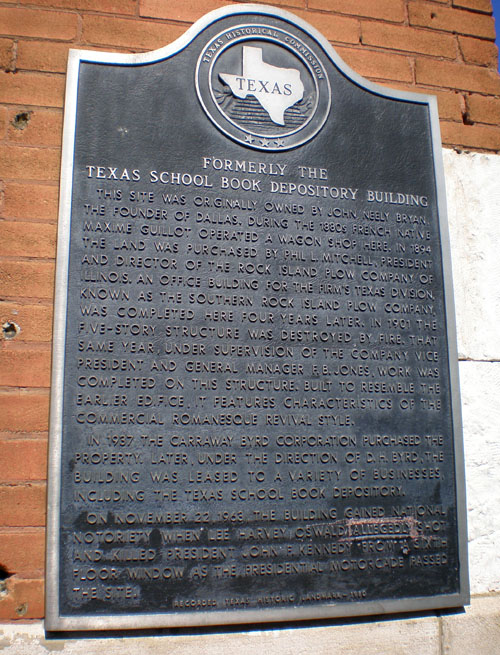
This is the historic placard posted on corner of the building. You can't see him, but to the right, there is a very annoying man trying to sell a JFK assassination tourist paper. Hint: Don't buy it. It's a waste of money. You will see everything you need to, if you choose, inside the museum. And you can take your own photos outside.
If you cross the street from the School Book Depository, you enter Dealey Plaza where a memorial sits to JFK directly behind the grassy knoll where he was assassinated in 1963.

There's a very large water feature, including a fountain and bunch of park benches in the shade. For the scene of such a horrific event in American history, it's actually quite a peaceful place to sit and read a book or just escape the unforgiving Texas sun.
These are pictures of the memorial to JFK. The memorial is located to the right of the water feature, directly behind the grassy knoll.

The plaque at the bottom of the monument.


On the wall in front of the white memorial is a diagram and plaque detailing the historic events in 1963.


If you walk a few blocks away from Dealey Plaza, you will find this plaque set in the sidewalk. It marks John F. Kennedy Memorial Plaza.
Jacqueline Kennedy designed this memorial for her husband. I find it odd. For such a prolific President of his time, this memorial doesn't speak to me about much of JFK's life or legacy.


Here are a few more photos from inside and outside the  white block monstrosity.


If these photos didn't amuse you, hopefully, they might inspire you to include either these settings or events in history in one of your own fictional works or to find a historic location in your hometown to tour and research for future reference. And if you can't get to Dallas any time soon, at least you got a virtual tour today of some of the highlights.
As always, happy writing and happy reading to all!


Friday, October 14, 2011

Vampire Books to Die for – Guest Blog by Erin O’Riordan

Vampire trends come and go in pop culture, but I can’t get enough of these undead blood-drinkers. Maybe it’s nostalgia for the late-night horror movies my brother and I used to stay up and watch with my dad. Maybe it’s the guilty-pleasure thrill a girl who was raised Catholic feels when she imagines cavorting with damned, soulless creatures that serve darkness. Most likely, though, it’s the vampire’s forbidden erotic allure: the hypnotic eyes, the piercing fangs, the fact that they’re played by total hotties on TV and in the movies. In my imagination, they’re even hotter.


Bram Stoker’s Dracula, written entirely in the form of letters and journal entries, is an excellent read and still very much worthy of your attention if you haven’t gotten to it yet. Post-Stoker, I tend to prefer paranormal romances to horror, but this is only a tendency. A few of my favorites include: ~Little Vampire Women, by Louisa May Alcott and Lynn Messina. I do love a good literary mash-up, and this one squishes together bloodsuckers and one of my all-time favorite novels. It contains every bit of the fun of Alcott's immortal girl-power classic, except this time the March girls have...well, immortal powers. They’re supposed to, anyway, though vampire hunters have unleashed a plague on the undead community that endangers poor, dear Amy. Laurie is a mortal, and still not immune to the charms of his feminine neighbors, even if they do want to drink his blood.


(Top: Christian Bale as Laurie from the 1990s film version. Bottom: the cover of Little Vampire Women)

~The Casa Dracula Books, by Marta Acosta. The first book, Happy Hour at Casa Dracula, is thoroughly enjoyable. In this witty novel, Acosta creates a wonderful heroine in Milagro de los Santos. Mil, as she is known to friends, just wants what every woman wants: to be taken seriously as a writer, to live in a rat-free apartment, and maybe to find a fabulous guy to get serious with. That guy is definitely not Sebastian, her ex, who's sitting on top of a pile of dark secrets. Along comes Oswald, who may be a vampire, and whose secrets may or may be of the dark variety. Wonderfully written, funny, and romantic, this book is a definite winner – and the series only gets better from there, as Mil is torn between Oswald and his less straight-laced cousin, Ian Ducharme. The final book, Haunted Honeymoon, completely satisfies.

~J.R. Ward’s Black Dagger Brotherhood series. The series is about a race of vampires who coexist with humans. Rather than feeding off humans, these vampires need to feed from the opposite sex of their own kind. The race was created by a goddess-figure known as the Scribe Virgin. Her nemesis, the vampire devil, is called The Omega. An elite clan of warriors, the Brotherhood, protects civilian vamps from The Omega's soulless army, the Lessening Society, or Lessers. The "Brothers" are not literally brothers (except Phury and Zsadist, who are twins).

Ward's writing style takes a little getting used to for those new to the series. She writes in a very noir-ish style. I believe she's heavily influenced by Robert B. Parker. She also invented a language the vampires use, which they call The Old Language. She peppers her novels with Old Language words like shellan and hellren ("wife" and "husband").

The thing about J.R. Ward's BDB novels that makes them so hard to put down is the way she keeps her pairs of lovers separated through so many hardships before she'll finally let them get together. That's the basic plot of every one of these novels, starting with the story of Wrath and Beth in the first book, Dark Lover. Every single one of the Brothers is absolutely gorgeous, all six feet tall and pumped up like comic book superheroes. My favorite is Zsadist--called Z--with his multicolored hair kept super-short, canary-yellow eyes that turn black when he's angry and terrifying exterior that belies how tenderly he loves his mate, Bella.


(photo by Eric Lin, Creative Commons license)

Perhaps the best short story Ward ever wrote is “The Story of Son,” which appears in the anthology Dead After Dark. Not part of the Brotherhood series, it’s an oddly affecting piece of dark erotica starring a vampire.

~Many Bloody Returns, by Charlaine Harris et al. There are many charming tales in this collection of paranormal stories on the theme of birthdays. The Sookie Stackhouse story by Charlaine Harris that begins the collection is only so-so, as is the last tale by Toni L.P. Kelner. (It does have a clever title, though. "How Stella Got Her Grave Back"--delicious!) The really memorable, unique tales include Bill Crider's "I Was a Teenage Vampire" (a Catcher in the Rye-meets-Dracula tale), "The Mournful Cry of Owls" by Christopher Golden (love that Eastern European folklore!), and "The Witch and Wicked" by Jeanne C Stein. In fact, "The Witch and Wicked" ends too abruptly. Expanded, it would make a nice stand-alone novel. The other stories are at least interesting, making for a better-than-average anthology.

About the author: Erin O’Riordan’s fabulous fictional vampires include 1950’s chef Oliver and stripper Oakley. “Vampires” is one of her most frequently used tags on her book blog, Pagan Spirits.